
What a BTU is
BTU stands for British Thermal Unit, a unit of energy: the heat needed to raise one pound of water by one degree Fahrenheit. When an air conditioner is sold as "12000 BTU", it means 12000 BTU per hour, the amount of heat it can remove from a room in an hour.
European manufacturers also give capacity in kilowatts (kW). The conversion is simple:
1 kW ≈ 3,412 BTU/h
| Commercial size | Approximate cooling capacity |
|---|---|
| 7000 BTU | 2.0 kW |
| 9000 BTU | 2.5 kW |
| 12000 BTU | 3.5 kW |
| 18000 BTU | 5.0 kW |
| 24000 BTU | 7.0 kW |
A common mix-up: cooling capacity (kW of heat) is not the electricity the unit uses. A 3.5 kW unit draws far less electricity than that, because it's a heat pump: it moves heat rather than creating it.
Why size matters
Too small: on hot days the unit runs flat out and never reaches the set temperature. It uses a lot of power and you're still uncomfortable.
Too big: the most common mistake, and the least intuitive. The unit cools the room quickly, switches off, switches on again, and repeats. In these short cycles it doesn't run long enough to pull moisture out of the air, so the room ends up cold but clammy. Inverter units soften this because they modulate their output, but every inverter has a minimum below which it starts cycling too.
The goal is a unit that runs most of the time at part load, steadily.
The three-step method
Step 1: base load from floor area
Multiply the room's area (m²) by a figure describing the home. These are rule-of-thumb values for normal ceiling heights, up to about 2.7 m:
| Type of room | Watts per m² |
|---|---|
| Well insulated, little sun, middle floor | 90 W/m² |
| Typical | 110 W/m² |
| Strong afternoon sun, large windows, top floor or roof above | 140 W/m² |
Step 2: add the extras
- People: about 120 W for each person beyond two who regularly uses the room.
- Open-plan kitchen: about 500 W, because hobs and ovens give off a lot of heat.
- Equipment: computers, large TVs, servers, around 100 to 200 W per workstation in an office.
- High ceilings: if the ceiling is above 3 m, multiply the total by the ceiling height divided by 2.7. Many older Lisbon apartments have ceilings well above 3 m.
Step 3: convert and pick the commercial size
Convert watts to kW and compare with the table above. Choose the next commercial size up, without jumping two sizes.
Three worked examples
A 12 m² bedroom, middle floor, little sun
- Base: 12 × 90 = 1,080 W
- Extras: none
- Total: about 1.1 kW
The smallest unit on the market is about 2.0 kW (7000 BTU), already almost double what's needed. In a small, shaded bedroom, choose an inverter that modulates well at low output, and never step up to 9000 BTU "to be safe".
A 28 m² west-facing living room with open kitchen
- Base: 28 × 140 = 3,920 W
- Open kitchen: + 500 W
- Four people regularly: + 240 W
- Total: about 4.7 kW
Choice: 18000 BTU (5.0 kW). A 12000 BTU unit would struggle on summer afternoons.
A 20 m² home office with high ceilings in an older Lisbon building
- Base: 20 × 110 = 2,200 W
- One workstation: + 150 W
- Ceiling 3.4 m: × 3.4 / 2.7 ≈ × 1.26
- Total: about 3.0 kW
Choice: 12000 BTU (3.5 kW).
What about multi-split?
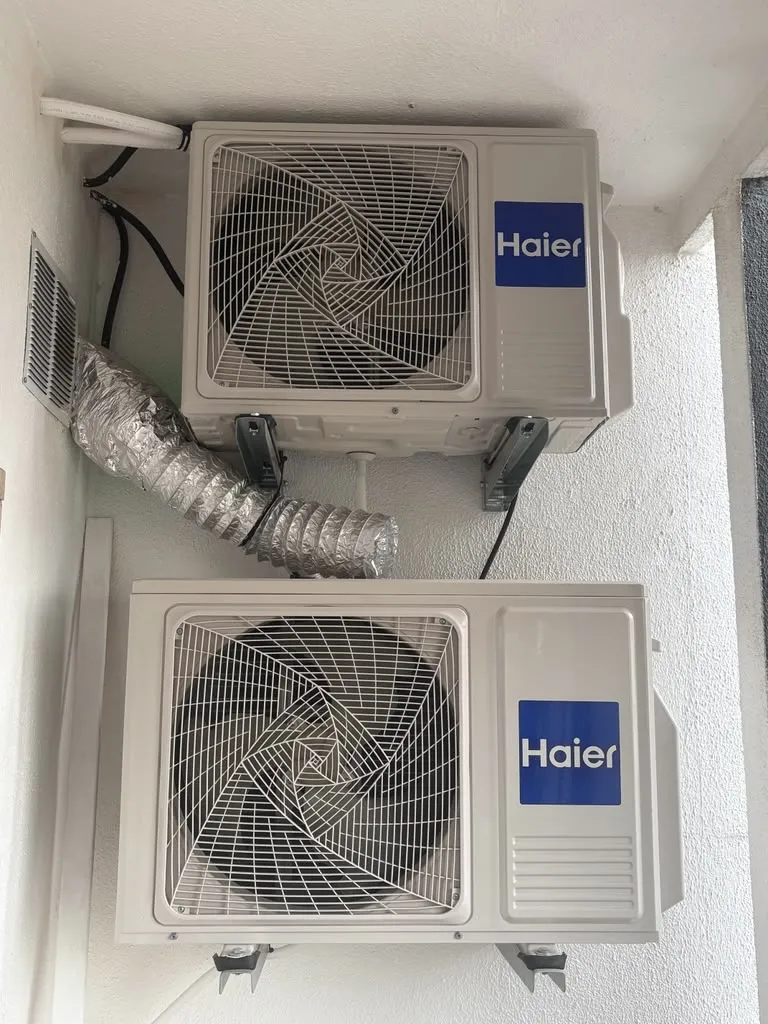
With a multi-split, each room gets its own indoor unit, sized as above. The outdoor unit doesn't have to equal the exact sum of the indoor units: since they rarely all run flat out at once, manufacturers allow combinations whose total exceeds the outdoor unit's capacity, within limits set for each model. That's why multi-split sizing must be done with the manufacturer's tables, combination by combination.
And for heating?
Heat-and-cool units also have a heating capacity, usually slightly higher than their cooling capacity. In the Lisbon and Setúbal climate, a unit sized correctly for summer will normally heat the room well in winter too. If your main goal is heating the whole house, compare with an air-to-water heat pump: see air conditioning vs heat pump.
The most common mistakes
- Buying on price per BTU. Bigger isn't a better deal if it ends up oversized.
- Ignoring orientation. A west-facing room needs much more than a north-facing room of the same size.
- Forgetting the open-plan kitchen. It's one of the biggest heat sources in the home.
- Using one unit for several rooms with doors closed. Air doesn't travel through closed doors; each closed room needs its own indoor unit.
- Ignoring ceiling height. In older Portuguese buildings, the volume of air makes a real difference.
- Forgetting the outdoor unit's location. A unit baking in full sun on a terrace loses capacity on the hottest days, exactly when you need it most.
When to call a technician
This method gives a good ballpark. On a technical visit we also look at wall and roof insulation, window type, shading from neighbouring buildings and how you actually use the room. For a whole home, we size each room and propose the right combination of units. See air conditioning installation.
Frequently asked questions
Usually 7000 BTU (2.0 kW), or 9000 BTU if the room gets strong afternoon sun or sits under the roof.
Between 12000 and 18000 BTU, depending on sun exposure, glazing and whether the kitchen is open-plan.
Only if they form one continuous open space. With doors closed, the air won't reach the second room.
It reduces the problem, because it modulates output, but every inverter has a minimum. Below it, short cycling returns.
At first, yes, but that's the trap. It reaches the set temperature quickly and then cycles on and off, leaving the air damp and the temperature uneven. A correctly sized unit takes a little longer to get there and then holds the room steady, which is what actually feels comfortable.
You can use this guide's method as one: area × W/m², plus the extras, converted to kW. For a whole home or a multi-split, sizing should be done room by room on a visit.
Add about 100 to 200 W per workstation to the base load, as in step 2. A room with three workstations and a printer can need a size above what its floor area alone suggests.
If the kitchen is closed off, yes, because hobs and ovens add a lot of heat. If it's open-plan, the living room unit covers it, sized with the extra 500 W.