
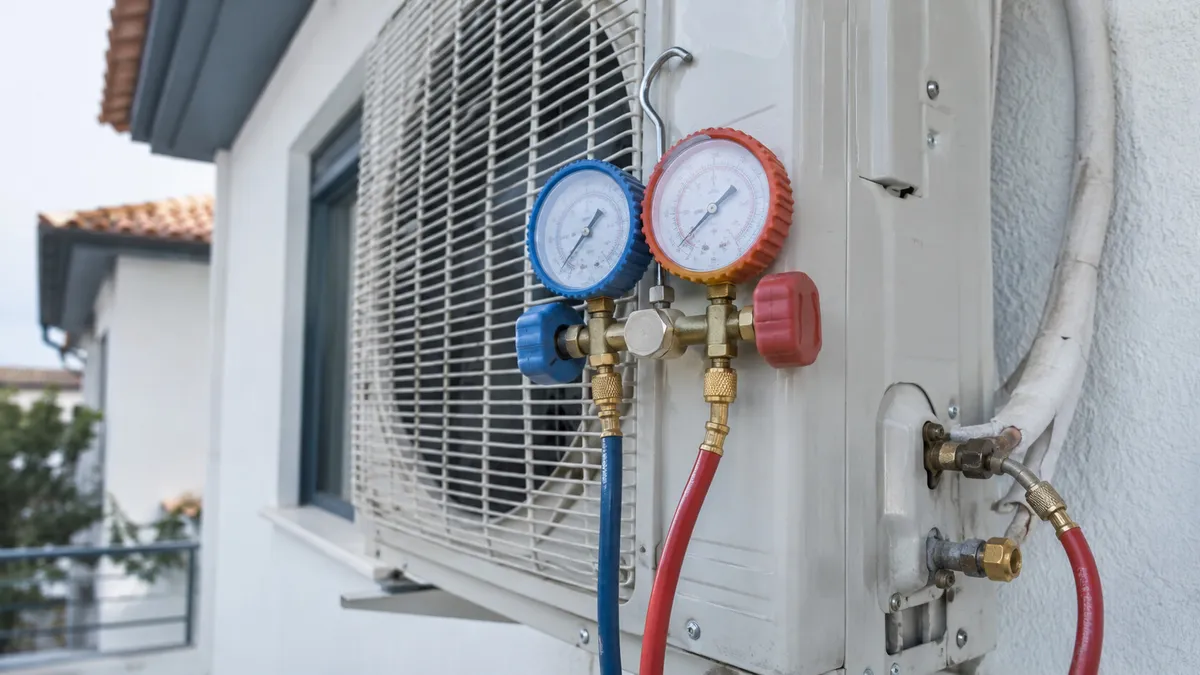
At IB Clima, every repair starts with a diagnosis. We come to you, find the cause, explain it in plain English, give you the price, and only then repair. We work on every major brand.
Symptom, likely cause, what we do
| Symptom | Most common causes | What we do |
|---|---|---|
| Not cooling or not heating | Very dirty filters and coil, refrigerant leak, faulty sensor or control board, compressor | Clean and measure temperatures; if pressures are low, find and repair the leak before recharging |
| Water dripping from the indoor unit | Blocked condensate drain, dirty tray, wrong fall, failed condensate pump | Unblock and clean, correct the fall or replace the pump |
| Bad smell when it starts | Mould in the tray, coil or fan barrel | Full clean and disinfection of the indoor unit |
| Noisy | Dirty or unbalanced fan, loose mounts, damaged outdoor fan, vibrating pipes | Clean, tighten and adjust, or replace the part |
| Switches itself off and on | Temperature sensor, oversized unit, electrical issue, low refrigerant | Test the sensor, the power supply and the circuit |
| Ice on pipes or unit | Low refrigerant, blocked filters, poor airflow | Clean and check pressures and leaks |
| Error code on the display | Depends on brand and code | Read the code against the manufacturer's documentation and test the component it points to |
| Won't switch on | Power supply, breaker, remote, control board | Check the circuit and fuse board, test components |
Many of these faults start with poor cleaning. An annual air conditioning service prevents a good share of them. For more detail, read our guide to common air conditioner problems.
Refrigerant leaks and recharging
Refrigerant (mostly R32 and R410A in home units today) doesn't get used up. If a unit has lost gas, there's a leak in a brazed joint, a flare connection or a coil. The correct sequence is:
- Measure pressures to confirm gas is low.
- Find the leak with an electronic detector, bubble solution or a pressure test.
- Repair the joint, connection or part.
- Vacuum the circuit to remove air and moisture.
- Recharge with the amount specified by the manufacturer.
Handling fluorinated gases (F-gases) requires certification in the EU, and our technicians are certified. That's also why refrigerant must be recovered, not vented, when a unit is removed.
When repair isn't worth it
Sometimes the honest answer is that a repair doesn't make sense. We'll tell you when:
- the compressor has failed on an older unit and the repair approaches the cost of a new one;
- the unit uses an older refrigerant that is harder and more expensive to source;
- faults keep recurring and running costs are much higher than a current unit.
We'll walk you through the numbers. If you decide to replace, we remove the old unit with refrigerant recovery and install the new one. The decision is always yours.
How a repair request works
- Message us on WhatsApp or call, and describe what's happening. A photo of the unit's label or the error code helps a lot.
- Technical visit. We book a visit and tell you the fee beforehand.
- Diagnosis and quote on site. We explain the cause and the repair cost.
- Repair. If you agree, we repair, or come back once a part has arrived.
- Test. We run the unit in cooling and heating before we leave.
No call centre: the person who answers is the technician who comes to your home.
Before you call: three quick checks
- Remote batteries and mode. Is it set to cool, heat or dry, at the temperature you want?
- The breaker. Is the air conditioning circuit on? If it trips again when you switch on, stop and contact us.
- The filters. Clogged filters are the most common reason a unit cools poorly.
Brands we repair
Daikin, LG, Samsung, Haier, Panasonic, Hisense, Toshiba, Mitsubishi Electric, Fujitsu, Gree, Midea, Hitachi, Carrier and others. If your unit is still under the manufacturer's warranty, check the warranty terms with the seller or the brand first.
Repairs in holiday rentals
A unit failing mid-stay is one of the fastest routes to a bad review. If you manage a rental remotely, send us the error code or a short video on WhatsApp and tell us who will let us in. We'll diagnose, explain the options and, where possible, schedule the repair between guests.
Frequently asked questions
Our hours are Monday to Friday 8:00 to 18:00 and Saturday 8:00 to 12:00. We don't offer out-of-hours emergency call-outs.
We don't recharge without checking for the leak. If gas escaped, it will escape again. Finding and fixing the leak is what solves it.
Yes: wall splits, multi-splits, ducted and cassette units, in homes and commercial premises.
It depends on the fault, which is why we diagnose on site and quote before repairing. The technical visit has a fee we tell you before booking.
Yes. See heat pumps.
It depends on the fault and the unit's age. Cleaning, a sensor or a start capacitor usually make sense. A failed compressor on an old unit often doesn't: we compare the repair cost with a new unit, and the decision is yours.