
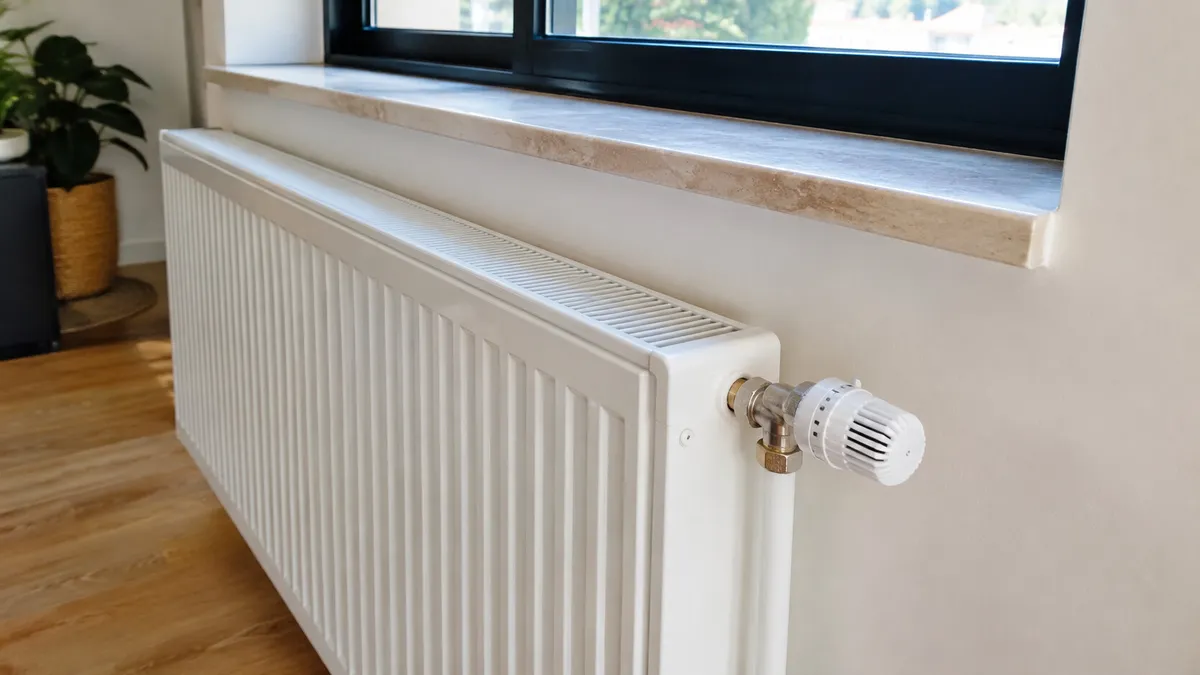
Central heating does the opposite: one heat source keeps the whole home at a steady temperature, with control room by room. We design and install complete systems, from the heat source to the emitters: heat pump or electric boiler, pipework, radiators or underfloor heating, and thermostats.
How a central heating system works
A central heating system has four parts that work together. If one is badly sized, the whole system underperforms.
| Component | What it does | Options |
|---|---|---|
| Heat source | Heats the water in the circuit | Air-to-water heat pump or electric boiler |
| Distribution | Carries hot water to each room and returns it | Multilayer or copper pipe, manifolds, circulation pump |
| Emitters | Release heat into the room | Radiators or underfloor heating |
| Controls | Switch on, off and regulate temperature | Zone thermostats, thermostatic radiator valves, timer |
How these parts combine decides comfort and running costs. A heat pump is most efficient with moderate water temperatures, which favours underfloor heating or radiators sized for low-temperature operation.
Keeping your radiators, changing the heat source
Already have radiators with an old boiler and want to switch to a heat pump? Often you don't need to replace everything. Radiators and pipework can stay, provided that:
- the radiators have enough output at the heat pump's operating temperature;
- the pipework is sound, with no leaks or heavy scale;
- the circuit is flushed and balanced before the new unit is connected.
We check the radiators room by room. Where one falls short, we replace just that one with a larger model.
Radiators or underfloor heating
- Radiators: heat up faster, are easier to fit in a lived-in home and can reuse existing pipework.
- Underfloor heating: even, gentle warmth from the floor up, nothing on the walls, low water temperature that suits a heat pump. Requires work on the floor.
Read underfloor heating vs radiators for a full comparison. You can also combine them: underfloor heating in living areas, radiators or towel rails in bedrooms and bathrooms.
Zoning: heat where and when you need it
A good system doesn't heat the whole house at the same temperature all day. We split the home into zones, each with its own thermostat:
- Day zone: living room and kitchen, warm in the morning and evening
- Night zone: bedrooms, warm before bedtime
- Bathrooms: separate control, often with a heated towel rail
With a timer, the system warms the house before you get home and drops the temperature when you're out. That's where you gain comfort without wasting energy.
Hot water from the same system
With a heat pump as the heat source, it can also produce your hot water through a storage cylinder, so one appliance handles heating and showers. See the configurations on heat pumps.
What we check in an existing home
- Insulation: windows, walls and roof. A poorly insulated home needs more output, and sometimes improving insulation first pays off.
- Existing installation: whether radiators and pipes can be reused.
- Plant space: where the heat source, hot water cylinder and manifold will go.
- Outdoor unit location for a heat pump: airflow, noise and access.
- Electrical supply and fuse board: the heat source needs a dedicated circuit, which we handle as electricians.
How we work
- Technical visit to see the home, its insulation and existing installation. We tell you the visit fee before booking.
- Proposal explaining the solution, output and emitters, with a quote.
- Installation of heat source, pipework, manifolds, emitters, electrics and controls. On renovations we coordinate with the pre-installation and the other trades.
- Commissioning: filling, bleeding, balancing, programming and a walkthrough in English.
Bathrooms and towel rails
Cold bathrooms are a classic Portuguese winter complaint. Connecting a heated towel rail to the central heating circuit warms the room, dries towels and helps keep condensation and mould down, with its own control so it can run when the rest of the house is off.
Frequently asked questions
Yes. Radiators are the least disruptive option: pipes can run along skirting, through false ceilings or in discreet trunking. Underfloor heating means lifting floors, so it suits renovations.
A heat pump delivers several times more heat than the electricity it uses. Actual costs depend on insulation, the temperatures you choose and running hours. Zoning and timers make a big difference.
At the moment we install central heating with heat pumps and electric boilers.
Yes: pressure checks, bleeding radiators, cleaning filters and adjusting controls. Before winter is the best time.
It depends on the size of the home and the solution. Swapping the heat source and keeping radiators is much quicker than a new system with underfloor heating. We give you the timeline with the proposal.
Yes, with compatible thermostats or heat pump controls. It's useful if you travel or want the house warm before you arrive.
Yes. A towel radiator connected to the central heating warms the bathroom quickly, dries towels and helps control damp. It can be added to an existing system with its own valve.