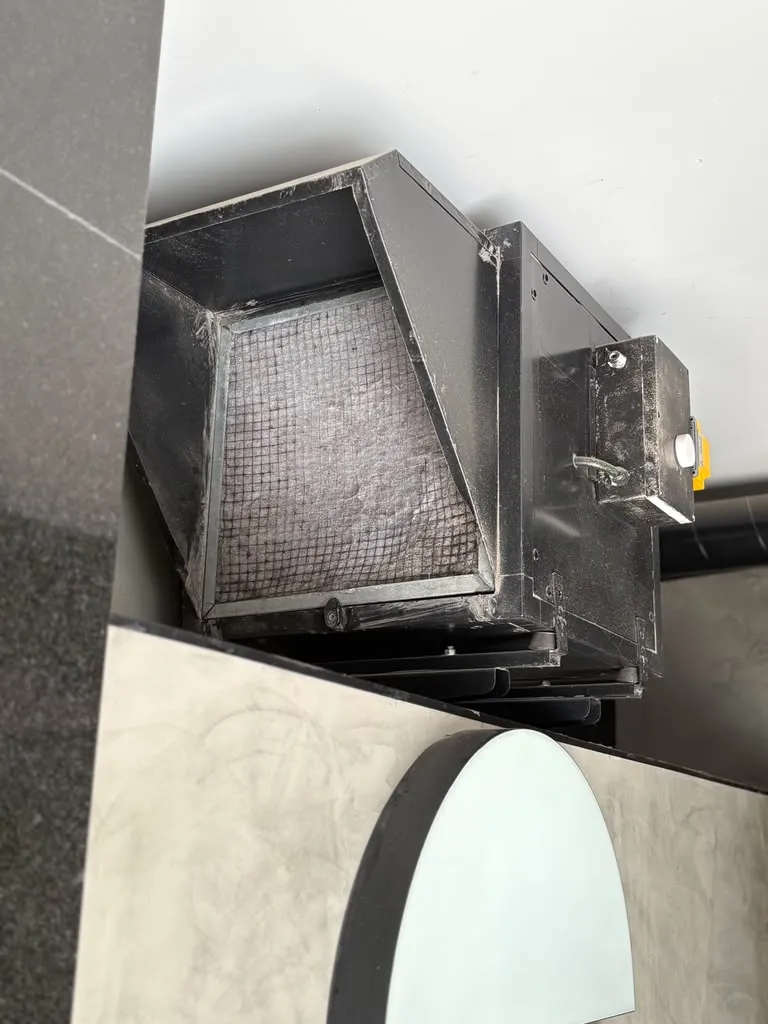
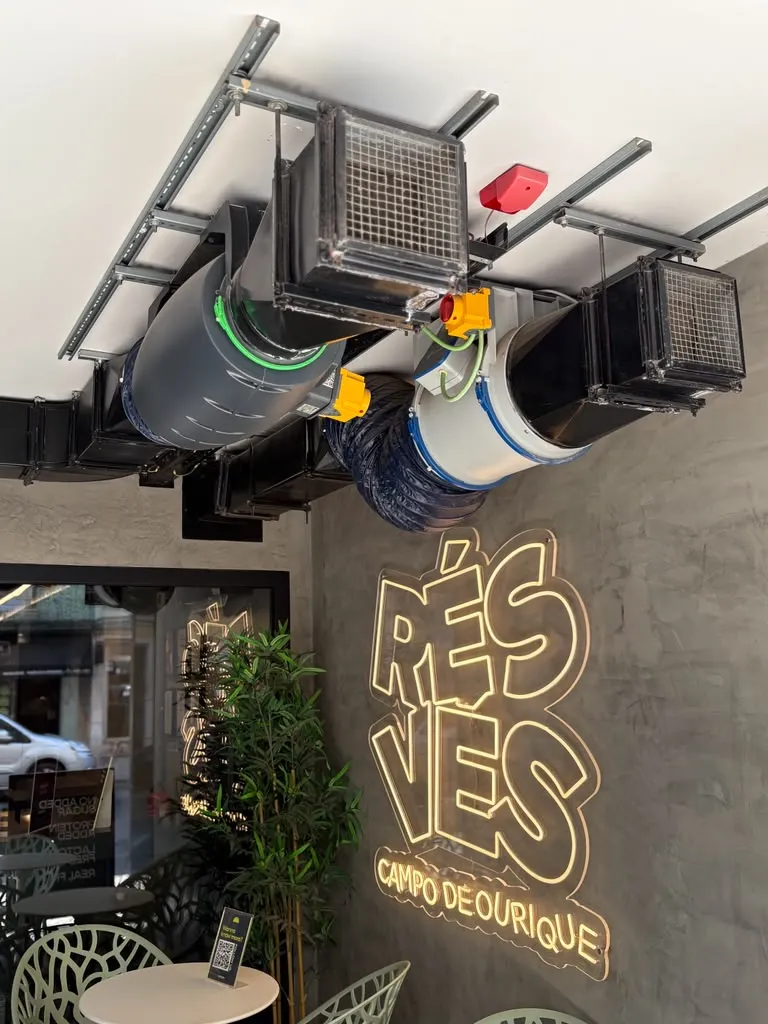
We install mechanical ventilation systems (known in Portugal as VMC) and dehumidification solutions in homes, apartments and commercial premises. The photos on this page show a ventilation system we installed in the ceiling of a café in Campo de Ourique, Lisbon.
Signs of a poorly ventilated home
| Sign | What's happening |
|---|---|
| Condensation on windows in the morning | Indoor air holds more moisture than it can keep when it cools against the glass |
| Mould in corners, behind furniture, on the bathroom ceiling | Persistent moisture on cold surfaces |
| Musty or stale smell | Air isn't being replaced; smells and moisture build up |
| Laundry slow to dry indoors | Air already saturated |
| Allergies and breathing discomfort worse in winter | Mould and dust mites thrive in damp air |
| Cold walls and peeling paint | Condensation on the wall surface |
Opening windows helps, but nobody keeps them open long enough in winter, and the heat escapes. Mechanical ventilation replaces the air continuously and in a controlled way.
Extract-only or heat recovery (MVHR)
Extract-only (single flow) A fan continuously extracts air from wet rooms (bathrooms, kitchen, laundry). Fresh air comes in through small vents in the windows or frames of the bedrooms and living room. Simple and lower cost to install, ideal in renovations.
Heat recovery ventilation (MVHR, double flow) Two duct networks: one extracts stale air, the other supplies filtered fresh air. They cross in a heat exchanger that uses the warmth of the outgoing air to warm the incoming air. You get fresh air without chilling the house in winter, and pollen and dust are filtered. It needs space for ducts, usually in a false ceiling, and suits new builds or major renovations.
We assess the home during the technical visit and recommend the right system.
Dehumidification
Not all damp can be solved with ventilation. In basements, garages, homes near the river or the sea, or holiday homes left closed for months, moisture may need to be removed actively. The options we assess:
- Properly sized mechanical ventilation, when the issue is a lack of air exchange
- Your air conditioning's dry mode, effective in rooms that already have it
- A fixed dehumidifier installed for spaces with persistent humidity
If the damp comes from leaks or rising moisture in walls or the roof, we'll tell you: that's a building problem to fix at the source before any equipment.
Ventilation for cafés, restaurants and offices
Commercial spaces have more people, more equipment and, in hospitality, cooking. Air exchange has to be sized for that. We install supply and extract systems with in-line duct fans and filter boxes, exposed or hidden in a false ceiling, like the café system in the photos. Servicing means checking fans and replacing filters. For businesses, see commercial.
Ventilation and air conditioning work together
Air conditioning heats, cools and removes some moisture, but it recirculates the same air; it doesn't bring fresh air in. Ventilation brings fresh air in, but doesn't heat or cool. In a well-designed home, the two complement each other, and we can handle both in the same project: see air conditioning installation.
How we work
- Technical visit, fee confirmed beforehand. We look at where damp appears, the rooms, windows and space for fan and ducts.
- Proposal with the right system and duct route.
- Installation of fan, ducts, extract or supply valves and air inlets.
- Electrical connection and airflow balancing room by room.
- Walkthrough of how it works and how to look after the filters.
What we don't do
We install ventilation systems and their ducts. We don't clean ventilation ductwork. For cleaning ducted air conditioning units, see air conditioning maintenance.
Holiday homes left closed
A home shut for months without ventilation often greets you with a musty smell and mould on the walls. A low-speed ventilation system or a fixed dehumidifier keeps the air moving and the humidity down while you're away.
Frequently asked questions
A well-sized system runs at low speed most of the time and is discreet. The fan sits in a technical space (false ceiling, storage) and ducts get silencers where needed.
Ventilation fans use little power because they run continuously at low speed. With heat recovery, you also lose much less heat.
Extract-only systems are installed with limited disruption: a fan, ducts to the bathrooms and kitchen, and window vents. Heat recovery needs more duct space and suits building work.
It helps in one room, but treats the symptom. If the home lacks ventilation, the damp returns as soon as you switch it off. Ventilation tackles the cause.
It depends on the system, the number of rooms and the duct route. An extract-only system in an occupied home costs less than heat recovery installed during works. We quote after the visit.
It reduces it a lot. Condensation forms when moist indoor air meets cold glass. By renewing the air continuously, ventilation lowers indoor humidity, so less water forms on windows and in corners.