
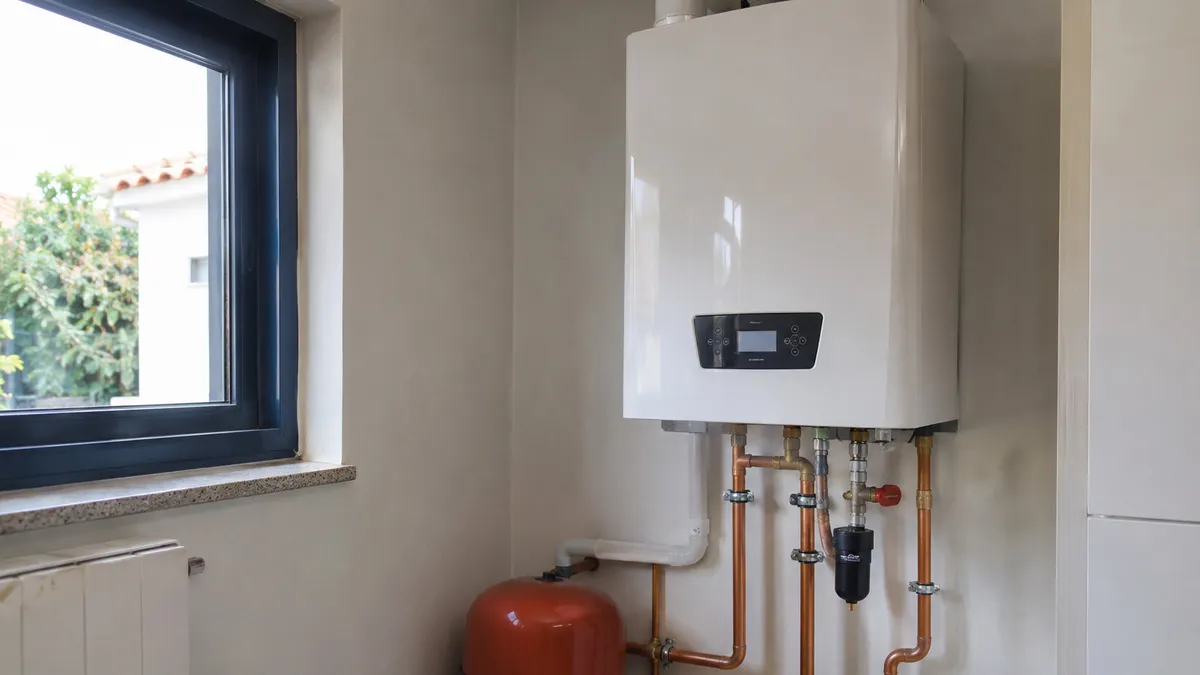
We install, service and repair electric boilers for central heating and hot water across Greater Lisbon, the South Bank and the Setúbal district.
How an electric boiler works
Inside, an electric boiler is simple:
- Electric elements heat the water in the heating circuit.
- A circulation pump pushes that water through radiators or underfloor pipes.
- An expansion vessel absorbs the water's expansion as it heats.
- Electronic controls switch the elements on in stages, according to the heat demand.
- Safety devices: safety thermostat, pressure switch and safety valve.
Some boilers also produce hot water, either directly or through a storage cylinder. With no combustion there are no flue gases, no chimney and no smell. It's installed like any high-power electrical appliance: a dedicated circuit with the right protection in the fuse board.
When an electric boiler makes sense
| Situation | Electric boiler | Heat pump |
|---|---|---|
| Apartment with no space for an outdoor unit | Good option: entirely indoors | Hard without an outdoor location |
| Small or well-insulated home, light heating use | Good option: lower upfront cost | Works too, but payback takes longer |
| Large home, heating many hours a day | High running cost | Better: uses several times less electricity for the same heat |
| Backup to a heat pump | Can act as top-up | — |
| Low contracted power | May require a power increase | Also needs power, but much less |
In short: an electric boiler is cheap to install and simple, but turns electricity into heat one-for-one. A heat pump costs more upfront but uses far less electricity. We install both and show you the numbers for your home.
Contracted power
In Portugal, every home has a contracted power level with its electricity supplier (for example 3.45 kVA or 6.9 kVA). An electric boiler draws a lot, so before installing we check:
- the contracted power on your electricity contract;
- whether the fuse board has space and protection for the new circuit;
- whether the supply is single-phase or three-phase, and which model suits it.
If the power or the fuse board needs upgrading, we handle the electrical side in the same job. See electrician.
What the installation includes
- Technical visit to see the space, the fuse board and any existing heating, with the fee confirmed beforehand.
- Choosing the model by output, supply type and whether it should also make hot water.
- Wall fixing in an accessible place for servicing.
- Water connections to the radiator or underfloor circuit, with isolation valves and a filter.
- A dedicated electrical circuit with the right breaker.
- Filling, bleeding and pressurising the circuit.
- Setting temperatures and timer, and a walkthrough in English.
Radiators or underfloor heating
An electric boiler works with both. With radiators, the home warms up faster, useful if heating only runs for a few hours a day. With underfloor heating, water runs cooler and warmth is more even, but the system responds slowly and works best running steadily. Either way, zone thermostats and a timer are what keep running costs down. See the full picture on central heating.
Servicing
With no combustion, servicing is simpler than for a gas boiler, but it still matters:
- Circuit pressure and expansion vessel check
- Bleeding air from radiators and the circuit
- Checking and tightening electrical connections and elements
- Testing safety devices
- Cleaning filters and checking the circulation pump
Before winter is the right time, so the system starts without surprises when you need it.
Common faults
- No heat or little heat: burnt-out element, faulty contactor, low circuit pressure.
- Breaker trips: faulty element or supply circuit problem.
- Pressure keeps dropping: a leak in the circuit or an expansion vessel that has lost its charge.
- Radiators cold at the top: air in the system, fixed by bleeding.
We diagnose on site and give you the repair price before going ahead.
Moving away from gas
Some owners renovating older Lisbon apartments decide to remove the gas supply altogether, for safety, simplicity or to avoid a second utility contract. An electric boiler or a heat pump replaces the old gas boiler for heating, and an electric or heat pump water heater covers hot water. We plan the electrical side so the new appliances fit within your contracted power.
Frequently asked questions
Each kWh of electricity gives roughly one kWh of heat. In a well-insulated home with zoning and a timer, consumption stays reasonable. For heating a large house many hours a day, a heat pump is more economical.
Often, yes. We check the radiators and pipes, flush the circuit and connect the new boiler.
At the moment we work with electric boilers and heat pumps.
Some models do, either instantly or with a cylinder. Otherwise the boiler is paired with a water heater or a heat pump water heater.
Yes. With no combustion there's no carbon monoxide risk and no flue. It needs a correctly sized circuit and protection, which we install.
Yes. Underfloor heating runs on lukewarm water, which an electric boiler can supply with suitable controls. If efficiency is your priority, compare it with a heat pump: see heat pumps.