
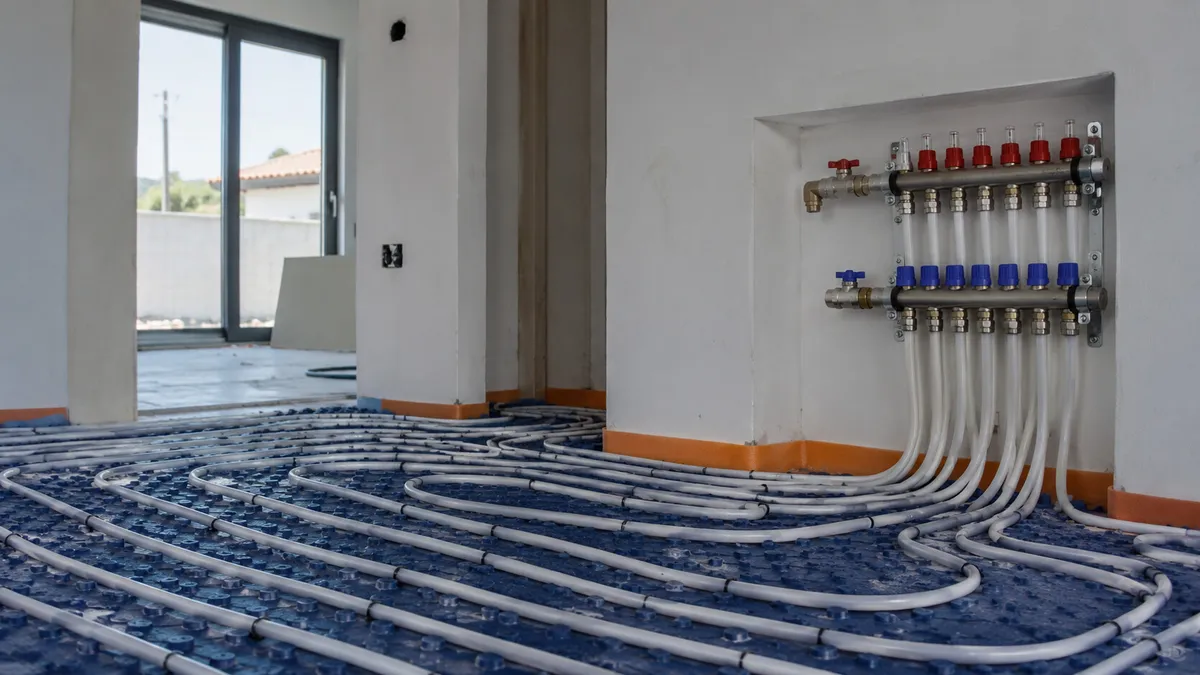
We install water-based (hydronic) underfloor heating, with warm water circulating in pipes beneath the floor, connected to a heat pump. In new builds and renovations across Greater Lisbon, the South Bank and the Setúbal district.
The layers of a water-based underfloor system
Underfloor heating is built in layers, and a mistake in any one of them affects the result:
| Layer (bottom to top) | Purpose |
|---|---|
| Slab or existing floor | Structural base |
| Thermal insulation boards | Stops heat going down into the slab or the flat below |
| Edge strip | Absorbs screed expansion along the walls |
| Pipe loops | Carry the warm water, laid in a serpentine or spiral pattern at calculated spacing |
| Screed | Surrounds the pipes, stores and spreads the heat |
| Floor finish | Tile, stone, vinyl or wood suitable for underfloor heating |
Each room's loops connect to a manifold, usually in a wall cabinet, which distributes water and lets each zone be adjusted.
Why it pairs so well with a heat pump
Because underfloor heating warms a large surface, the water doesn't need to be very hot: it runs at much lower temperatures than traditional radiators. That's exactly where a heat pump is most efficient. Lower water temperature means less electricity for the same comfort. In a new build or major renovation, underfloor heating with a heat pump is one of the most efficient ways to heat a home.
New build or renovation
In a new build, underfloor heating fits naturally: floor levels are planned from the start to include insulation, pipes and screed. We do the pipework at the right stage, coordinated with the other trades; see pre-installation.
In a renovation, the existing floor has to come up and the system's thickness has to be accounted for. Floor level may rise by a few centimetres, which affects doors and thresholds. Low-profile systems exist for these cases. We measure during the visit and tell you whether and how it can be done.
Before you decide
- Floor finish: tile and stone conduct heat well. Wood and vinyl also work if rated for underfloor heating.
- Response time: underfloor heating warms up slowly and holds heat. It works best running steadily on a schedule rather than switched on and off.
- Zones: each room or group of rooms can have its own thermostat. Cooler bedrooms, warmer living room.
- Insulation: the better the insulation, the lower the water temperature needed and the lower the running cost.
Still comparing with radiators? Read underfloor heating vs radiators.
The complete system
Underfloor heating is an emitter. It needs a heat source and controls. We install the whole system: heat pump, manifolds, loops, thermostats and, if you like, hot water from the same unit. See how it fits together on central heating.
How we work
- Technical visit to the site or home, with the fee confirmed beforehand.
- Design: area of each room, insulation, floor finish and loop calculation.
- Quote for the complete solution.
- Installation of insulation, pipes and manifold, with a pressure test before screeding.
- Connection to the heat source, filling, bleeding and setup.
- Gradual first start-up, once the screed has cured.
Maintenance
Pipes inside the screed don't need maintenance. What gets checked periodically is accessible: circuit pressure and expansion vessel, the manifold's valves and flow meters, the system filter, and the heat pump's regular service. We do this before winter, together with the heat pump service.
Combining underfloor heating and air conditioning
Many homes in Lisbon and Cascais end up with both: underfloor heating for winter comfort and air conditioning for hot summers. Planning them together during the renovation means one team, one schedule and pipework that doesn't clash in the ceilings or floors. See air conditioning pre-installation.
Frequently asked questions
It depends on the total area, insulation type, pipe spacing, heat source and whether it's a new build or a renovation. We quote after the visit, with everything included listed.
We install water-based systems heated by a heat pump, which have lower running costs for heating larger areas.
With a reversible heat pump, a water-based floor can provide some cooling, within limits to avoid condensation on the floor. For proper summer cooling, air conditioning remains the most effective solution.
Yes, especially in full renovations. We need to confirm the available floor depth and space for the manifold and heat source.
Pipes designed for underfloor heating are made to last for decades in the screed. The parts that need servicing, the heat source and manifold components, stay accessible.
Thin rugs are fine. Thick rugs and large furniture without legs reduce the heat reaching the room, so it's worth planning furniture before the loops are laid.
Yes, and it's one of the most comfortable places to have it: warm floor, faster drying and less condensation.
Yes. Each loop runs to the manifold, and rooms or zones can have their own thermostat. That way, bedrooms can stay cooler than the living room, and rooms you rarely use can be kept at a lower background temperature.